

Picture a young couple sitting at a kitchen table, laptop open, reviewing a recent job offer and comparing what their paychecks would look like if they lived in Florida, Tennessee or Indiana. They’re hard workers who want a good school for their kids, a career where they can advance and get ahead, and a tax bill that doesn’t make them feel punished for trying. And more and more, the math keeps pointing south.
This isn’t a hypothetical. It’s playing out across Michigan, household by household, zip code by zip code. Facts matter. Taxes matter. And when we look to why people move into some states and out of others, their income tax burden – and resulting take-home pay – is one of the clearest answers the data gives us.
The Numbers Don’t Lie
Michigan’s personal income ranking has fallen from 19th in the country in 2000 to 40th in 2026. That’s not a blip, it’s a generation-long slide. And it has happened while state government grew, spending expanded, and Lansing kept promising that the next incentive package, the next growth council, the next round of corporate subsidies would finally turn the tide.
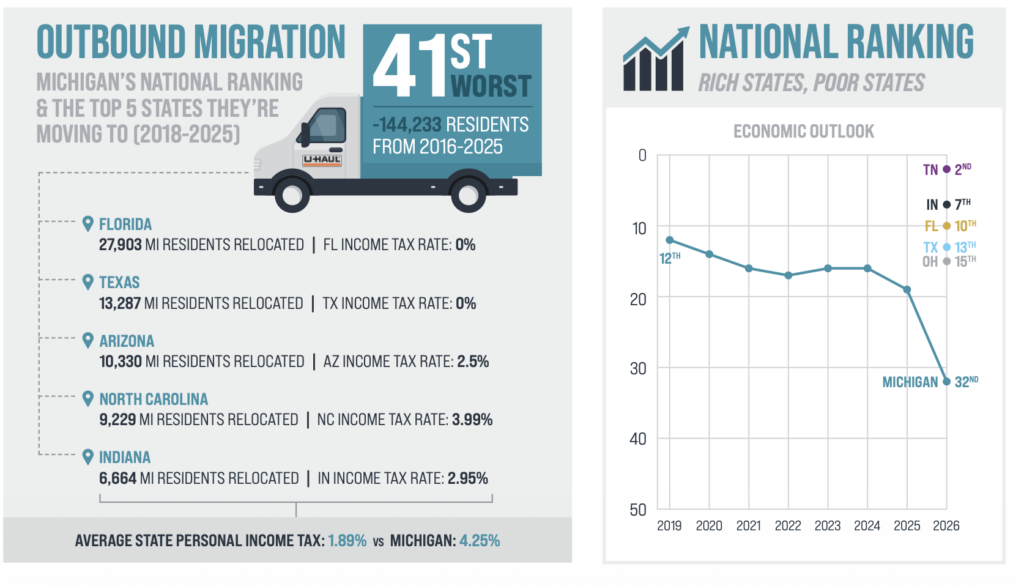
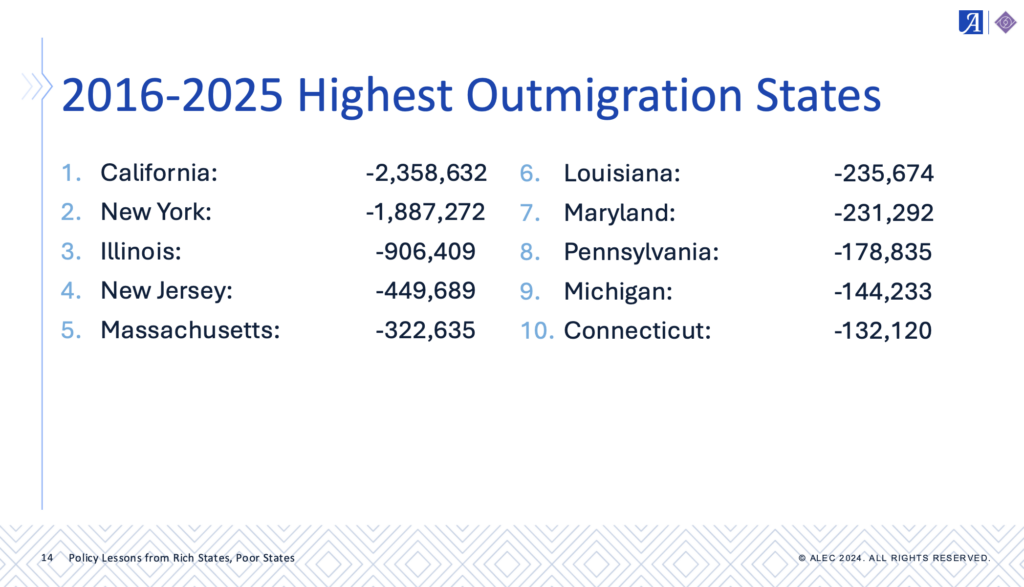
They haven’t. Michigan now ranks 41st worst in outbound migration according to the annual U-Haul ranking, and the authors of ‘Rich States, Poor States’ note that Michigan has lost more than 144,000 residents to domestic out-migration between 2016 and 2025. That’s not a rounding error. That’s like losing the equivalent of Michigan’s 3rd largest city; gone.
Where are they going? States like Florida, Texas, Arizona, and North Carolina; but before you think they’re moving too far South, Indiana and Tennessee are also top destinations. The average personal income tax rate across those destinations is about 1.5 percent. Michigan’s is 4.25 percent — well over double.

Workers and families move toward better career opportunities. They move toward places where the state doesn’t take a bigger cut before they can pay their mortgage, save for college, or invest in a business. That’s not ideology. That’s not just the record, that’s common sense.
The Competitive Picture
The Rich States, Poor States rankings, produced annually by the American Legislative Exchange Council, measure economic outlook across 15 factors including tax burden, debt levels, and regulatory environment. In 2019, Michigan ranked 12th. Today, Michigan ranks 32nd.
Meanwhile, Indiana sits 7th. Tennessee ranks 2nd. Florida is 10th. Ohio, our neighboring rival we refuse to lose to on a football field, has climbed to 15th. These aren’t accidents. They are the consequences of deliberate policy choices — choices to keep taxes low, reduce regulatory friction, and signal to families and businesses that they are welcome.
Michigan has sent a different signal. And 144,000 people responded with their feet.
The Responsible Path Forward
The argument you’ll hear against income tax elimination is that Michigan can’t afford it. That’s the wrong question. The right question is whether Michigan can afford to keep doing what we’re doing.
The answer is no — but a responsible path forward exists. It doesn’t require recklessness. It requires discipline.
- Structurally balance the budget with existing resources. Don’t raise taxes, don’t raise fees, don’t raid the savings account. Michigan currently has billions in discretionary spending through pet projects, corporate handouts, and bureaucratic overhead that could be redirected toward structural reform. The money is there. What’s missing is the will to prioritize it.
- Fund pension promises and stay the course. Michigan has made commitments to teachers, state troopers, and public employees. We must keep them. Staying on our current pension funding trajectory will fully meet those obligations and — on its own — can soon account for roughly one-quarter of all income taxes paid. Sound fiscal management now creates room for tax relief later.
- Exercise discipline. Sound decisions made today compound into big opportunities tomorrow. A state that eliminates waste, funds its obligations, and phases down its tax burden over time doesn’t just improve a ranking — it rebuilds the case for Michigan as a place worth choosing. And, if revenue is a concern, other states are showing that economic growth leads to healthy government funding.
Five of the ten fastest in-migration states in the country have no personal income tax at all. The top destinations for Michiganders who leave average just over 1.5 percent. We don’t have to match zero overnight. We have to start moving in the right direction — and commit to getting there.
What’s at Stake
This is not a debate about numbers on a spreadsheet. It’s a debate about whether Michigan is a state where the young couple at that kitchen table decides to stay.
My dad’s well-earned pension isn’t taxed. So why should my daughter’s hard-earned income from her small business be penalized? Why should the plumber who starts employing workers in Michigan pay more than twice the rate of the person who does the same thing in states attracting Michigan families?
Other states aren’t waiting for us to figure this out. They’re actively recruiting our workers, our businesses, and our families right now. Michigan can keep offering the same tired policies, or we can actually compete.
The path to a competitive Michigan isn’t complicated. It’s a commitment to fiscal discipline, honest budgeting, and getting the tax burden moving in the right direction. Michigan’s workers aren’t asking for favors. They’re asking to keep more of what they earn. That is a reasonable ask. It deserves a serious answer from Lansing.